Project Duration
01.06.2026 - 31.07.2029
Summary
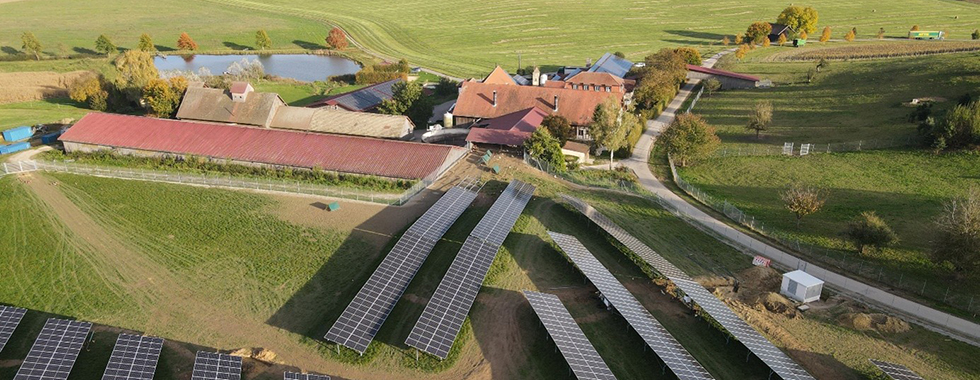
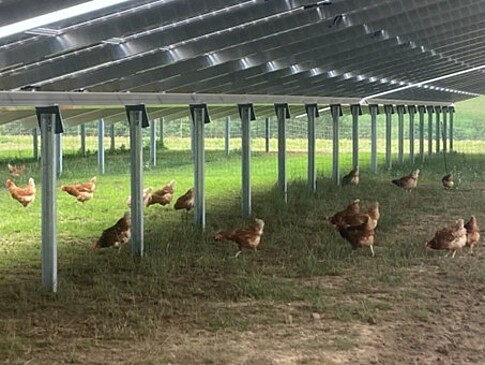
The HENergy research project develops and investigates innovative concepts for the sustainable use of free-range areas in organic laying hen farming. At the core of the project is the concept of “triple land use”, combining photovoltaic systems, agroforestry structures, and organic free-range laying hen husbandry on the same agricultural land. The aim is to integrate climate and resource protection, animal welfare, and economic viability while creating new perspectives for sustainable agriculture.
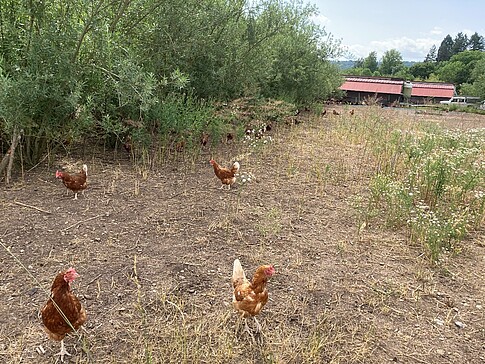
Agroforestry structures and PV systems create shaded, structurally diverse outdoor areas that meet the natural needs of the animals while also enabling additional energy and biomass production. In this way, the project contributes to the sustainable multiple use of agricultural land and supports the objectives of Germany’s Organic Farming Strategy and the Baden-Württemberg Organic Action Plan.
The project follows an interdisciplinary research approach. Within the field of animal husbandry systems, researchers investigate animal behavior in the outdoor range, land-use patterns, protection against predators, and innovative water distribution systems beneath photovoltaic modules. One challenge is that water accumulates along the drip edges of the modules, potentially causing erosion, puddling, and damage to vegetation. As part of this subproject, a simulation facility for water distribution systems will precede the field investigations in cooperation with Andreas Lemmer and the University of Hohenheim.
The field of agroecology, led by Maria Müller-Lindenlauf, analyzes the effects of the different land-use systems on vegetation, biodiversity, and nutrient dynamics. Research focuses on how plant cover, soil moisture, and nitrogen and phosphorus inputs change beneath and between the PV modules, and under which conditions stable and ecologically valuable vegetation can be maintained.
In addition, agricultural economics, led by Jürgen Braun, evaluates the economic viability of the combined land-use systems. This includes analyses of the economic potential of energy production, agroforestry systems, and the overall farm-level effects of multiple land use. The goal is to develop economically sustainable models for agricultural businesses.
Field studies are being conducted on three farms in Baden-Württemberg. In addition to two existing pilot farms with PV systems on laying hen ranges, special focus is placed on the organic farm Hofgut Martinsberg, where an existing agroforestry system is being adapted for triple land use with a PV installation. By comparing conditions before and after the installation, the impacts of the new land-use concept can be comprehensively assessed. Through its practice-oriented and interdisciplinary approach, HENergy provides valuable insights for the further development of organic husbandry systems and supports farms in implementing sustainable, animal-friendly, and economically viable concepts for the future.